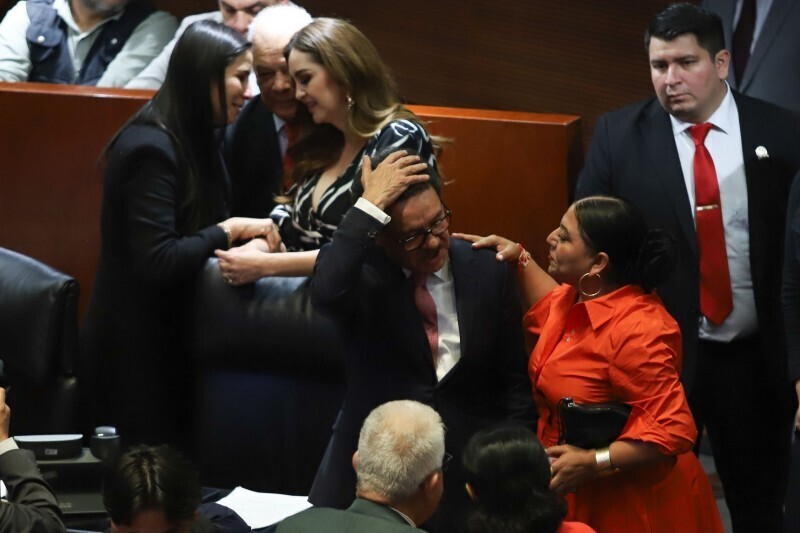
The Mexican Senate approved in general and in particular the 'Plan B' electoral reform proposed by President Claudia Sheinbaum, with 87 votes in favor and 41 against. The document has now been sent to the Chamber of Deputies for discussion and approval. Thus, the recall of mandate will take place in 2028, as established by the Constitution. During the session, senators from MORENA, PAN, PRI, Verde, and Movimiento Ciudadano presented various proposals to amend the bill, but they were not accepted by the Senate Plenary, so articles 115, 116, and 134 were approved. It was the PT senator, Lizeth Sánchez García, who requested the removal of changes to article 35 on the recall of mandate. Therefore, this figure remains in the current terms of the Political Constitution. However, the amendment to Article 35 of the Constitution, related to the recall of mandate, was removed after a reservation was presented by the Labor Party. The initiative was approved with the support of MORENA, the Green Party, and the PT, although the latter decided not to accompany one of the central points of the bill, which generated tensions during the discussion in the Plenary. 'But the most important thing we want to point out is that our party is a founder of the Fourth Transformation, and with it we will continue to stand by our president Claudia Sheinbaum Pardo,' added Anaya. In defense of the recall of mandate reform, the MORENA senator, Malú Micher, assured that such a mechanism is a substantive expression of the principle of popular sovereignty and an instrument of democratic control. Sánchez García argued that the PT supports Sheinbaum Pardo's project, as well as the strengthening of popular participation, although she maintained that the recall of mandate and elections are mechanisms with different purposes that, when mixed in the same electoral process, 'there is a risk of distorting their democratic sense.' Hours earlier, when setting the position of her caucus, Senator Beto Anaya had announced that they would vote in general in favor of Plan B, but would separate from Article 35 on the recall of mandate. 'It is not a symbolic figure, it is a tool that transforms the way power is exercised,' he said, and added that with this reform 'the mandate ceases to be immutable' to be subject to the scrutiny of the people. However, after several weeks of discussion and the rejection of the Electoral Reform, Sheinbaum's new proposal came out decaffeinated from the upper house, without its main ingredient and due to the lack of support from one of MORENA's allies: the Labor Party. 'We are separating from the content of the bill in what refers to article 35 of the Constitution,' said the coordinator of the PT senators in the Senate. With the constitutional changes, the municipalities' city halls may be integrated with one syndicate and up to fifteen councilorships; also for the local level, it is added that the budget of local legislatures must not exceed 0.70% of the budget of expenditures of the respective federative entity. For electoral authorities, the bill specifies that the remuneration of counselors, magistrates, secretaries of the administrative bodies, and heads of executive and technical areas or their counterparts in the National Electoral Institute, the local public electoral bodies, and the electoral tribunals of the federative entities may not be greater than that of the head of the Federal Executive. In the third transitional provision of the project, it is also established that the annual budget authorized for the Senate of the Republic must be progressively adjusted during the next four fiscal years, with the object of reaching, at the end of that period, a cumulative reduction equivalent to 15%.