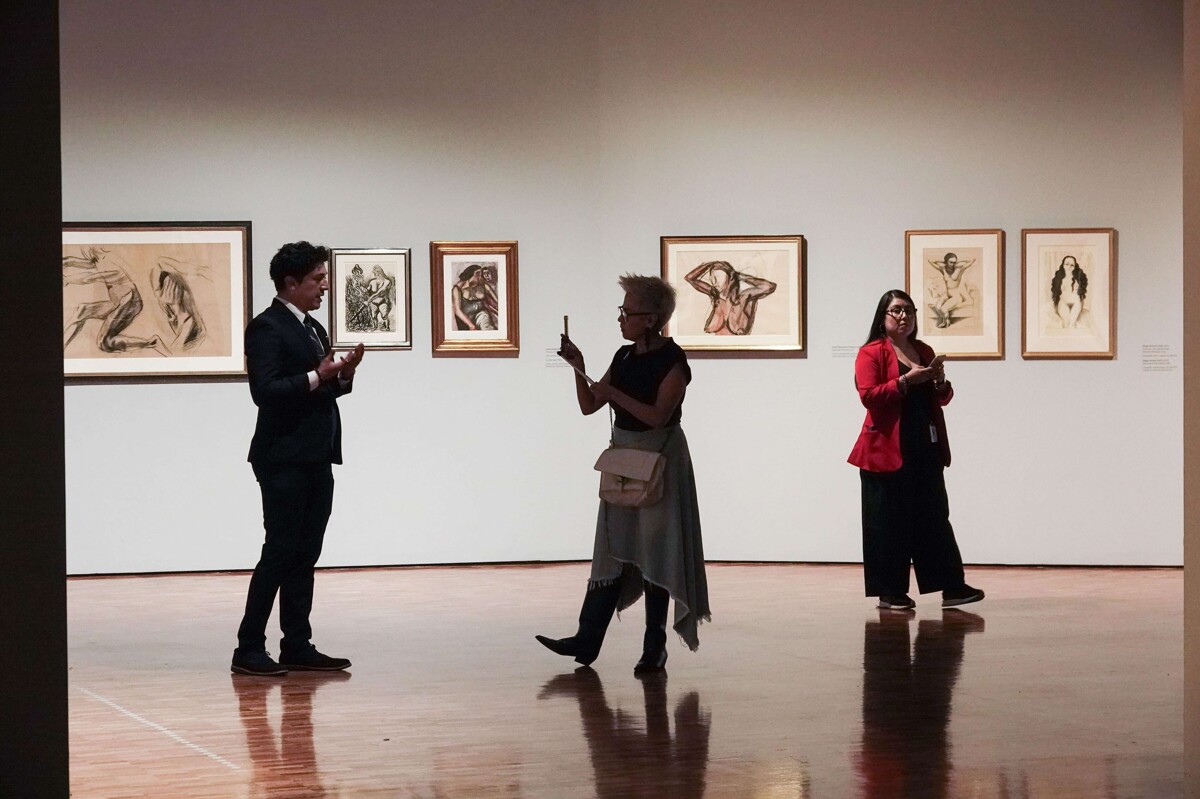
The controversy over the terms under which the Gelman collection will be housed at a Santander Bank facility in Cantabria requires explanations from those involved, mainly the banking institution and the Mexican government. On Wednesday, President Claudia Sheinbaum said at her morning press conference that she is interested in the collection staying in Mexico. Vega has already explained that there are exceptions and that work is being done on an agreement that would extend these deadlines. In the same vein, EFE (published by Infobae) highlighted: “Vega has explained that the obligation to travel from Santander to Mexico at least every two years to carry out customs procedures ‘does not seem best for the works,’ so Santander is studying with the INBAL ‘some formula that guarantees the best conservation and the least stress for the works,’ an agreement that ‘is in the interest of the parties.’” The correspondent for La Jornada was at the announcement and, in his article published in Mexico on January 22, noted that “despite insistence on some details of the negotiations and agreement, they invoked the ‘confidentiality’ of the pact to not reveal, for example, if there would be economic compensation to the Mexican family for this temporary transfer, or even the complete list of the works, which will be made public in June.” Therefore, while Santander insists that the agreement “in no case implies either the acquisition or the definitive transfer of the collection out of Mexico, whose ownership belongs to the Mexican collector family Zambrano (...)” and that “The Gelman Santander Collection will return to Mexico at the end of the temporary export period,” concrete questions arise: 'Diego in my thought,' 'Self-Portrait with a Necklace,' and 'Self-Portrait with Monkeys,' three of the 18 Frida Kahlo works in the Gelman collection of nearly 200 pieces, will they return to Mexico in two years or not? Why not display the permits processed for the 'temporary' export of what is boasted about in Spain as a 'long-term renewable deposit'? Could it happen that at the end of President Sheinbaum's six-year term, the 30 works declared 'national artistic monuments' do not return to Mexico, given that Santander will attend to 'hundreds' of requests from international museums? These are questions... about the artistic heritage of Mexicans. Subsequently, the National Institute of Fine Arts issued a bulletin stating that the 30 works declared national artistic monuments are not leaving permanently. However, what Santander bank is saying today is very different, and therefore could be said to be contradictory, with how it presented in Madrid in January what is now called the Gelman Santander Collection, with which they will open the El Faro cultural venue in June. Rather than highlighting the lack of clarity, it's better to provide some context and ask questions to Santander Bank, which on January 21, according to EFE, La Jornada, and the El Español portal, showed little willingness to clarify, let alone return the works to Mexico every two years. Citing Daniel Vega, director of El Faro, which will house the collection in the Cantabrian capital, El Español published that it is a 'long-term renewable deposit' (italics from the source, not mine) that has the support of the Ministry of Culture of Mexico and the National Institute of Fine Arts and Literature (INBAL), essential since several of the works are protected by Mexican law and must return to their country of origin every two years to analyze their condition. Everything sounds good, but much remains to be clarified.