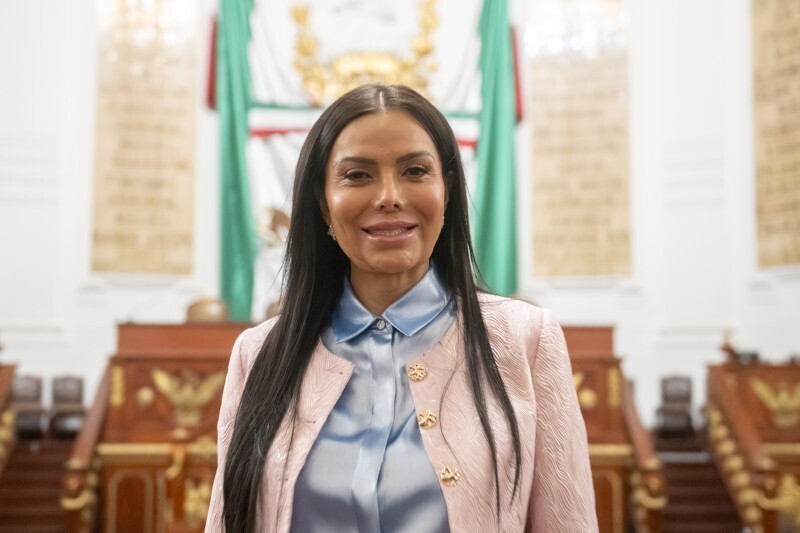
Local deputy Diana Sánchez Barrios, in an interview with LPO, stated that she will regulate street commerce and is analyzing a proposal by Sánchez Barrios. She said: "I will wait for my moment, but her concern gives us a very clear message when she mocks our gender identity." Later, she was left in the "freezer." We will continue working hand in hand and very close to the territory, as our president Claudia Sheinbaum well says, to know what is required, what is needed, and to be able to seek a better quality of life for those of us who inhabit this city and this country. Local deputy Diana Sánchez Barrios in dialogue with LPO. What are your main initiatives and work for this legislative year? — We will continue to work, above all, on the attention to priority populations. What we want to do is to reinforce it before the law to give security to people. When I go out to the territory, I find countless needs. I will continue to work for all solutions for priority attention, in culture, the sonideros, and for all the sectors that come and look for me. My difference with the mayor is that I am a woman who was born, grew up and lives in Cuauhtémoc, who comes from below and knows what need and poverty is until becoming a successful woman. We all know that the mayor does pure shows and social media. It is about putting norms and rules for everyone and for all. How would you rate the current situation of the Cuauhtémoc mayor's office? — It is enough to walk to see that it is in total abandonment. The merchants want to order commerce, but the authorities have not entered the issue with seriousness or commitment. In politics everything is uncertain. I hope she delivers her report and we are going to see what is reflected in the mayor's office because it is not noticeable. The agenda is movable because sectors arrive with needs that we have to attend. There are moments to wait. It is not only to say where to sell, but to train yourself so that the business is successful. What obligations would the street vendors have with this law? — If we are talking about more than 800,000 people, according to current statistics, imagine everything they could pay as taxes to the City so that that resource is used in favor of the territory so that the streets are fixed, where there can be a perspective of security and health. In the country there are more than 33 million merchants who sell in the public way and the issue is not minor. What does the law seek in legal matters? — It would establish special places, that is, where we, the merchants, would work so as not to be scattered everywhere. Security has to be reinforced, which is what people ask for the most. The agenda is movable because sectors arrive with needs that we have to attend. I work for the neighbors of Cuauhtémoc. This law seeks to reinforce that action throughout the city. In other issues are you working? — We always work for human rights and for the LGBTQ+ agenda because we have many shortcomings to resolve. We want to regulate what is already there, we are not inventing anything new. We all, the deputies of the fourth transformation, work in favor of all citizens, we have a head of government who is very attentive with the Utopias she is doing and with the social programs. There is a lot of commitment fulfilled and that is what is important: that the citizens see that what is promised is fulfilled. The people are fed up because they do not work and lies many times so that people believe it is true, but the facts speak for themselves. That is fear because she knows that I am the only one who can take that chair away from her. How is the unity of Morena in the mayor's office? — I see a lot of unity, I see that there are many talks. It should not affect those working families. That has to be in a dialogue with the merchants, with the representatives of the merchants, with the entrepreneurs, with the neighbors that open parliaments until achieving to know where those spaces of work are going to be and where definitely one cannot sell. I live and walk the mayor's office and the people say that there is no light, adults fall, people with disabilities cannot pass, there are abandoned parks. That is number one on my agenda because commerce has to be ordered. I think we are going to do very well in the city. We want the Congress to do an open parliament and open the dialogue to build in favor of all and all: where are the work spaces going to be, where are we going to work, where are we not going to work, what work schedules, trainings and strengthen the merchant so that he is a successful entrepreneur, because in the end we are a fundamental part of the economy of Mexico City. It is about seeking a benefit for all and all. What changed in Congress so that now it can be approved? — The last time we did not have the enough support of all the deputies. We have a big difference. She made a commitment and today she denies all that. That led to the deputies not taking it very seriously. That is why, this reform that we did recognizes street commerce as a dignified work, integrates it into the right to the city and orders its execution with clear, fair rules and with a human rights approach. This reform that we did recognizes street commerce as a dignified work, integrates it into the right to the city and orders its execution with clear, fair rules and with a human rights approach. When the Congress of Mexico City began, the civil society of commerce in public space organized in such a way that we presented the first initiative with preferential character in this city. If she is angry with me the issue is with me, not with the merchants. In addition, she is hitting public commerce because she sees in me a strong adversary and sees her chair in danger. One of the most important that I just uploaded is the reform that is for commerce in public space: the Chambeando Ando law. They have to be organized, ordered. That must go along with training. Trans women, for not having the right to health, we give ourselves a cocktail of hormones that ends up giving us cancer in the prostate, fatty liver, it deteriorates our health, we inject polymers that damage our health, we live with the flesh open and we have to fill ourselves with gauzes and that makes us with a terrible disability. We put that project to consultation so that they would grant us rights and obligations, how to order us and the special spaces where we have to work. One thing is to stand in the marches and scream and another is to execute in collective and that it becomes a reality. You are a representative of the trans community of the City, what are the main demands of this community? — This week was the day of trans visibility and we still lack rights, we lack a transversal unity. It is a policy that goes hand in hand with what the head of government is already doing with the merchants in the Historic Center. We are advancing. Two intellectuals are missing that we are working on. Thanks to those merchants that she hits today, she is in that chair. At that moment she only accompanied the RPI. Right to job quota, to housing and all these pending issues. The return, say in her team, served to continue at the head of the tasks she was already carrying out, but with greater responsibilities, tasks and reach for all of CDMX. In 2024, Diana Sánchez Barrios changed the daily work she did in the streets at the head of street commerce and the association that works for the rights of LGBTQ+ people to assume as a local deputy of the 4T. I campaigned with her and I seated her with the merchants. She did not have major consensuses. Today I upload it again because it is important. "We have a movable agenda because sectors arrive with needs that we have to attend," she manifested in dialogue with LPO in an extensive interview in which she analyzed the current situation of the Cuauhtémoc mayor's office, the elections of next year and her legislative agenda in favor of the "vulnerable populations". How do you analyze the local context of the City? — As they say, work kills weeds. When I go out to the territory I find countless needs. One of your proposals that generated repercussions was the one that seeks to regulate Airbnb, how is that topic? — It is a very important issue, but the far-right has been misinforming the citizens. One thing is now and in a week we do not know what happens. She won by 11 thousand votes and the merchants gave her 27 thousand votes. She has more than four thousand million pesos and that money is not seen. That is why, one of the requests are to have direct social programs for the trans population to go eh closing this gap. We are advancing, but we lack a lot. In what judicial moment is the judicial case for the attack you suffered? — They caught the one who shot me, the one who was on the motorcycle and the girl who was putting me. That is how we live 10 or 15 years and when we are 40 we look like people of 80 because we cannot even walk. I can prove with documents my activism. In the end, the Electoral Institute approved her with 45 thousand signatures. The Inter-American Court of Human Rights speaks of the portability of trans people and it is for that, because of discrimination. The government has a transversal health unit that opened last year, now it has to train all health centers to start migrating the community to the clinics that correspond to them. Nobody is prohibiting them from renting their property, nobody is prohibiting them, we simply want to put order and transparency: if they are going to rent their building, that they change the land use; if it is housing and they are going to share it that the land use remains residential. We are providing information, research and all the necessary elements to stop these two intellectual people that we lack. It will impact on the law of commercial establishments, on the law of urban development and on the law of the mayoralties. We are thousands and thousands of people who impact favorably more than two million people who are their relatives.