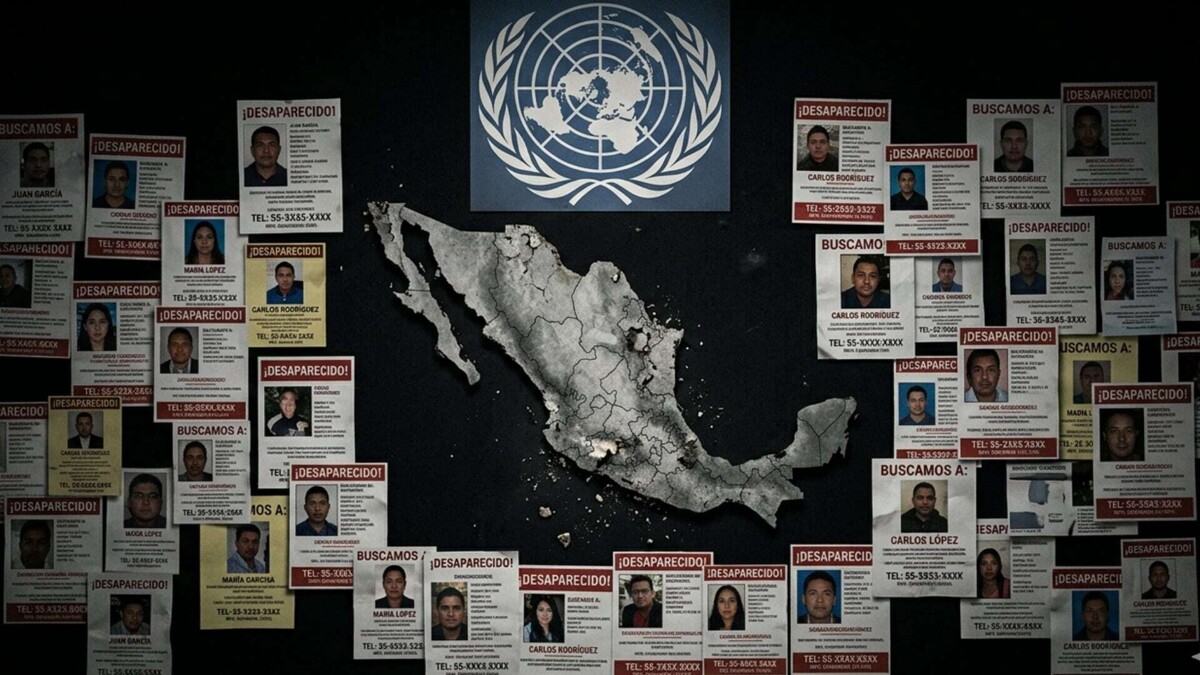
The UN Committee on Enforced Disappearances (CED) has responded to criticisms from the Mexican government and political actors following its recent report on the situation of disappearances in the country. Through its president, Juan Pablo Albán, the body defended the legality of its actions and called for the preservation of institutional respect, emphasizing that its objective is to strengthen international cooperation in favor of the victims. Committee defends the scope of the report In a public statement, Albán explained that treaty bodies 'are indeed part of the United Nations system' and that their function is to supervise the fulfillment of international obligations assumed by States. He added that committee members are elected by the countries themselves and act independently. Regarding the procedure applied, he noted that Article 34 of the Convention allows the matter to be brought before the General Assembly when there are 'well-founded indications' of widespread or systematic enforced disappearances. 'Our decision is not a referral or report to the OHCHR, but to the main deliberative body of the UN,' he clarified. He also rejected limiting the analysis to past administrations, stating that it assesses the evolution of the phenomenon to the present day. In this context, the Committee reiterated that its procedure has a preventive nature. It cited data reflecting more than 132,000 missing persons registered and a constant increase, as well as nearly 72,000 unidentified human remains in 2026. Calls to avoid disqualification The President of the CED maintained that 'disagreement is legitimate, but disqualification is questionable,' in reference to the criticisms of the Mexican government, which described the report as partial and biased. Similarly, he insisted that the central objective must be 'to strengthen prevention, search, and investigation' of the cases.