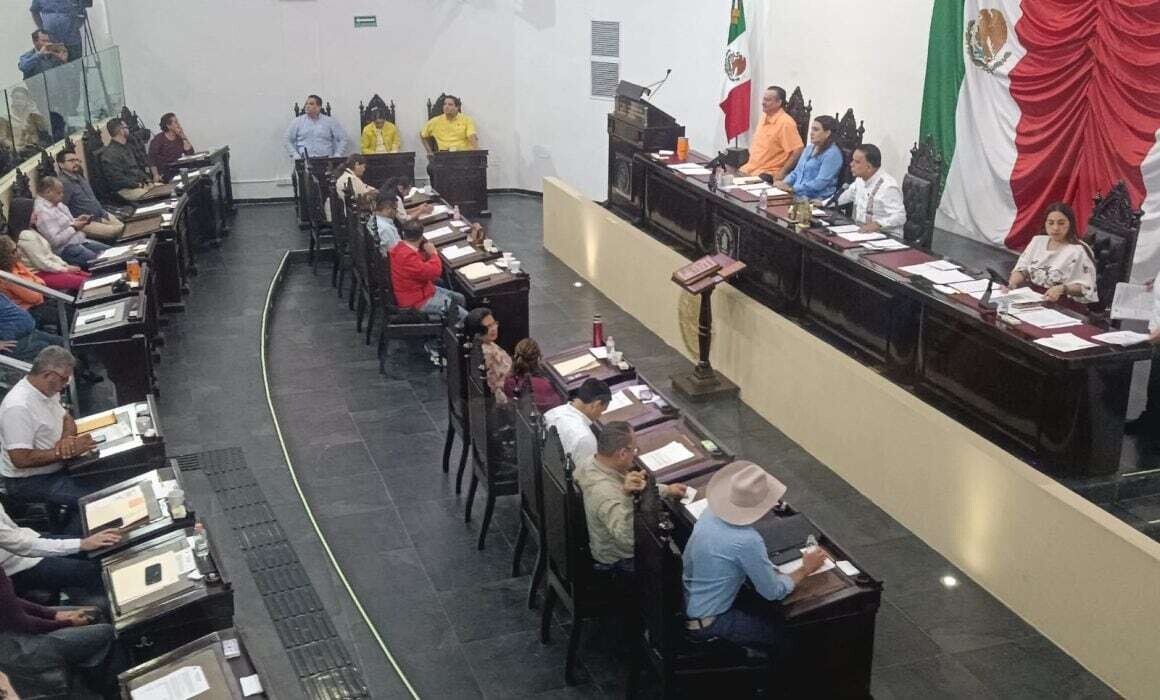
In a session that lasted into the early hours of Thursday, the Congress of the State of Tabasco became the first in the country to approve the electoral 'Plan B' promoted by President Claudia Sheinbaum. After several hours of a pause in legislative work, the bill with the draft decree was approved with 29 votes in favor and one against, around 3 AM. The session was called for the afternoon of April 8, but after the only three items on the agenda were read, it was decided to call a recess while waiting to receive the bill from the Chamber of Deputies, which was still in discussion at that time, as the debate lasted more than 16 hours. Once activities resumed, the only opposition to the bill came from Deputy Fabián Granier Calles, from the Institutional Revolutionary Party (PRI). In contrast, Deputy Orquídea López, from the PRD of Tabasco, voted in favor, being the only member of her bloc to attend the session, while Morena (which holds the majority), PVEM, PT, and MC approved the bill as expected. Local legislators did not submit any articles for general or particular discussion and limited themselves to a nominal vote, so the entire process took them less than 10 minutes. The reform contemplates modifications to articles 115 and 116, as well as the addition of a paragraph to article 134 of the Political Constitution of the United Mexican States. For this, adjustments are established in the composition and operation of city councils, the budgets of local congresses, and budgetary limits on the remuneration of electoral officials. These will be the changes with the electoral reform 'Plan B'. The approved modifications state that the composition of the City Councils will have a limit of up to 15 regencies, elected under the principles of vertical and horizontal gender parity, gender perspective, and substantive equality; as for the limit on the budgets of local legislatures, a cap of 0.70 percent of the state's budget is set. Similarly, the Constitutional Bill highlights that the salaries of high-level electoral officials are limited, so the salaries of councilors and electoral magistrates cannot exceed those of the President of the Republic. However, in Tabasco, local reforms were made in 2019 that include much of what is set out in 'Plan B'. It was the president of the Board of Directors, Marcos Rosendo Medina Filigrana, who ordered the corresponding decree to be issued, which will be sent to the head of the Executive Power of the State for publication in the Official State Gazette; similarly, an authorized copy will be sent to the Congress of the Union so that it is considered the Tabasco's favorable vote.