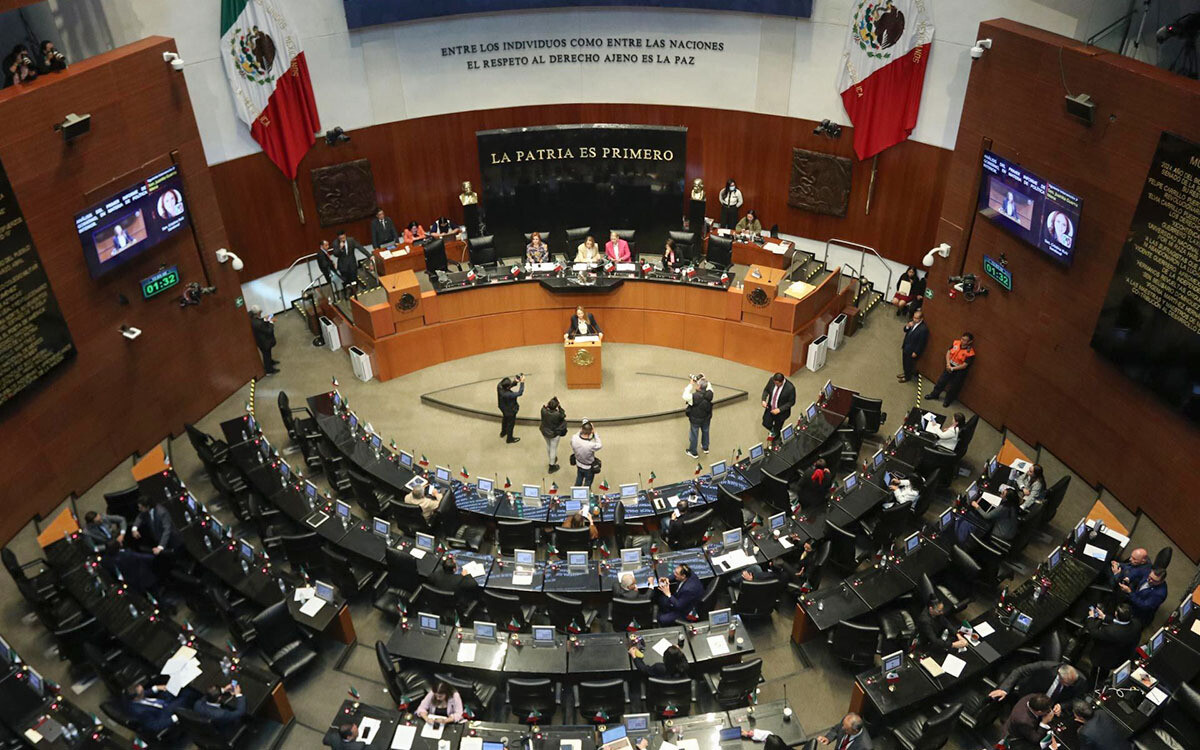
The Senate of the Republic unanimously approved a constitutional reform on Tuesday to strengthen the fight against femicide in Mexico, empowering the Congress of the Union to issue a general law on the matter. With 109 votes in favor, the Plenary approved amendments to Article 73 of the Constitution, seeking to establish legislation that defines a homogeneous criminal type, as well as sanctions and investigation criteria applicable nationwide. The bill was sent to the Chamber of Deputies for analysis and eventual approval. According to the ruling, derived from an initiative by President Claudia Sheinbaum, the future law will allow for coordinated actions between different levels of government to guarantee access for women and girls to a life free of violence, in addition to strengthening the State's capabilities to prevent, investigate, sanction and eradicate these crimes. The document specifies that the reform does not imply an additional budgetary impact. Currently, femicide is typified differently in state legislatures, which, according to the ruling, hinders a uniform response. To this end, the reform proposes to establish homogeneous bases for its typification, investigation and sanction, as well as to homogenize standards with a gender perspective and reinforce coordination between the Federation and the states. It also includes measures to guarantee access to justice and reparation of the damage to victims, as well as the protection of girls, boys and adolescents who are left orphaned by femicide. Martha Lucía Micher, from Morena, stated that femicide 'admits no delays' and qualified it as a serious violation of human rights. For the PAN, Verónica Rodríguez Hernández indicated that her favorable vote seeks to strengthen the protection of women and stressed that this crime represents one of the most serious expressions of gender-based violence. Meanwhile, the PRI senator, Paloma Sánchez Ramos, considered that the reform obliges the State to act against impunity and warned that gender-based violence represents 'a debt that the Congress has been accumulating for years'. For her part, Alejandra Barrales, from Citizen Movement, recognized the progress, although she warned that the problem requires additional measures: 'More profound actions are required, because this problem will not be solved simply with this project'. During the session, a reservation presented by the PRI senator Mely Romero Celis was admitted for discussion. This group, according to the ruling, faces 'emotional, social and economic' impacts that require comprehensive attention, including health services, psychological support and access to education. During the discussion, the president of the Constitutional Points Commission, the Morenista Óscar Cantón Zetina, affirmed that it is a reform of great relevance: 'We are not talking only about laws, but about women, girls, mothers, daughters, families that live with an empty chair and a State that can no longer fail'.