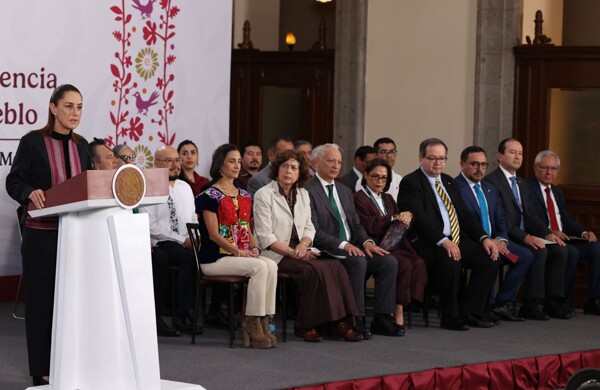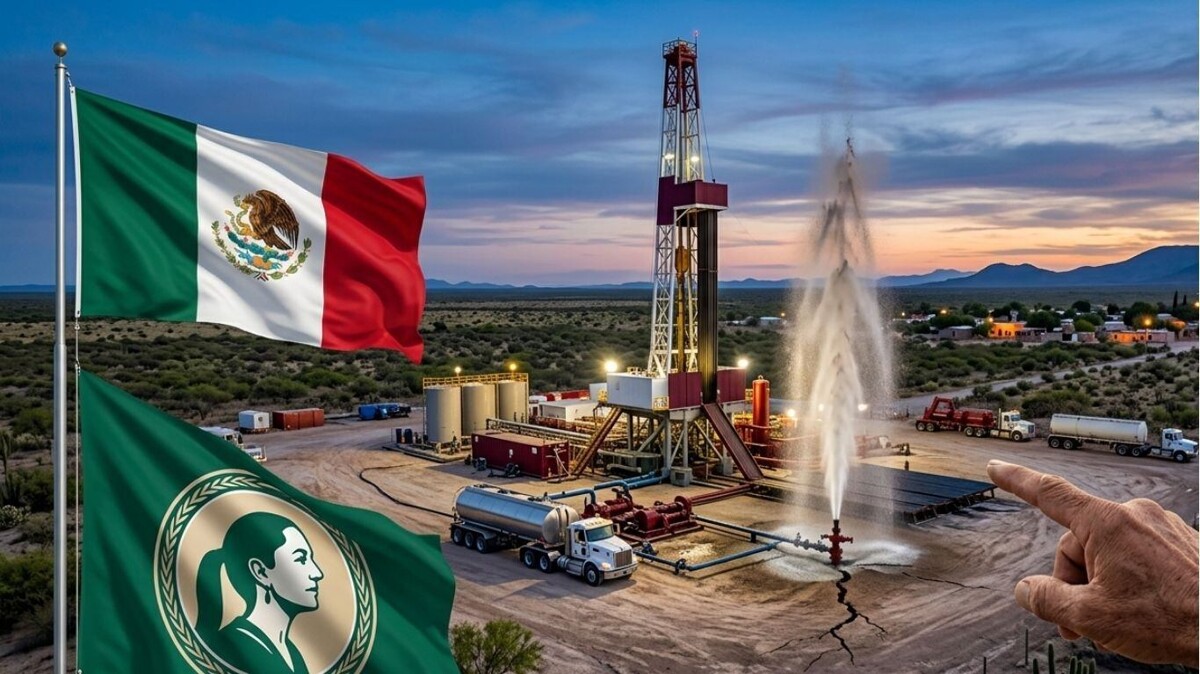
The president of Mexico, Claudia Sheinbaum, has reopened the debate on the use of fracking in the country by proposing that this technique could be analyzed as part of a strategy to reduce dependence on foreign gas. Although she had rejected its use for years, the head of state assured that the current context forces the evaluation of new alternatives, always under environmental criteria and with community consultation.
What is fracking and how does it work? Fracking, or hydraulic fracturing, is a technique used to extract gas and oil trapped in deep rock formations, known as shales. According to information from bodies such as the National Water Commission (CONAGUA), the Secretariat of Environment and Natural Resources (SEMARNAT), and studies from the UNAM, the process consists of:
Drilling: a vertical well is drilled, which is then extended horizontally in the rock layer. Injection: a mixture composed mainly of water (90%), sand (8-9%), and chemicals (1-2%) is injected at high pressure. Fracturing: the pressure breaks the rock and allows the gas or oil to flow towards the well. This technique has been key in countries like the United States, but it has also generated intense debate due to its impacts.
Sheinbaum's plan: sovereignty with less impact The president has pointed out that Mexico consumes large volumes of imported gas, which represents a challenge for energy sovereignty. In this context, she explained that her government is analyzing new technologies that would allow reducing the impacts of fracking, such as the use of biodegradable chemicals and water recycling.
"The worst thing we can say is no," she affirmed, emphasizing that the country must not close itself off to options that could strengthen its energy independence. However, she made it clear that any decision will depend on technical studies by experts and social consultation processes: "We will never override any community."
Social and environmental impact in Mexico The use of fracking in Mexico has been questioned for its effects on communities, mainly in the north and the Gulf regions.
Water competition A single well can require between 9 and 29 million liters of water, in areas that already face water stress, such as the Burgos and Sabinas basins.
Health risks Studies from UNAM and the Gaceta Parlamentaria warn that some chemicals used can cause respiratory, neurological damage, and in some cases, be carcinogenic.
Seismicity and the environment Microseisms have also been documented in exploitation areas, as well as risks of aquifer contamination.
Community impact In addition to the environmental impact, the development of these projects can generate social conflicts, community division, and changes in land use.
An open debate in Mexico During recent years, the official stance had been to curb fracking; however, in 2026 the topic returned to public discussion due to the need to strengthen energy security. While bodies like CONAGUA have warned about the risks to water, the federal government proposes to analyze its viability under new technologies and more sustainable schemes. The approach, as Sheinbaum has reiterated, will be to find a balance between energy development, reducing environmental impacts, and respect for communities.
The dilemma: energy or the environment The debate on fracking reflects a fundamental tension in Mexico: advancing towards energy sovereignty without compromising natural resources or the social fabric. For now, the government has not made a final decision, but it has made it clear that the topic is no longer ruled out.
"What we do not want is to close the door to Mexico's future," affirmed the president.