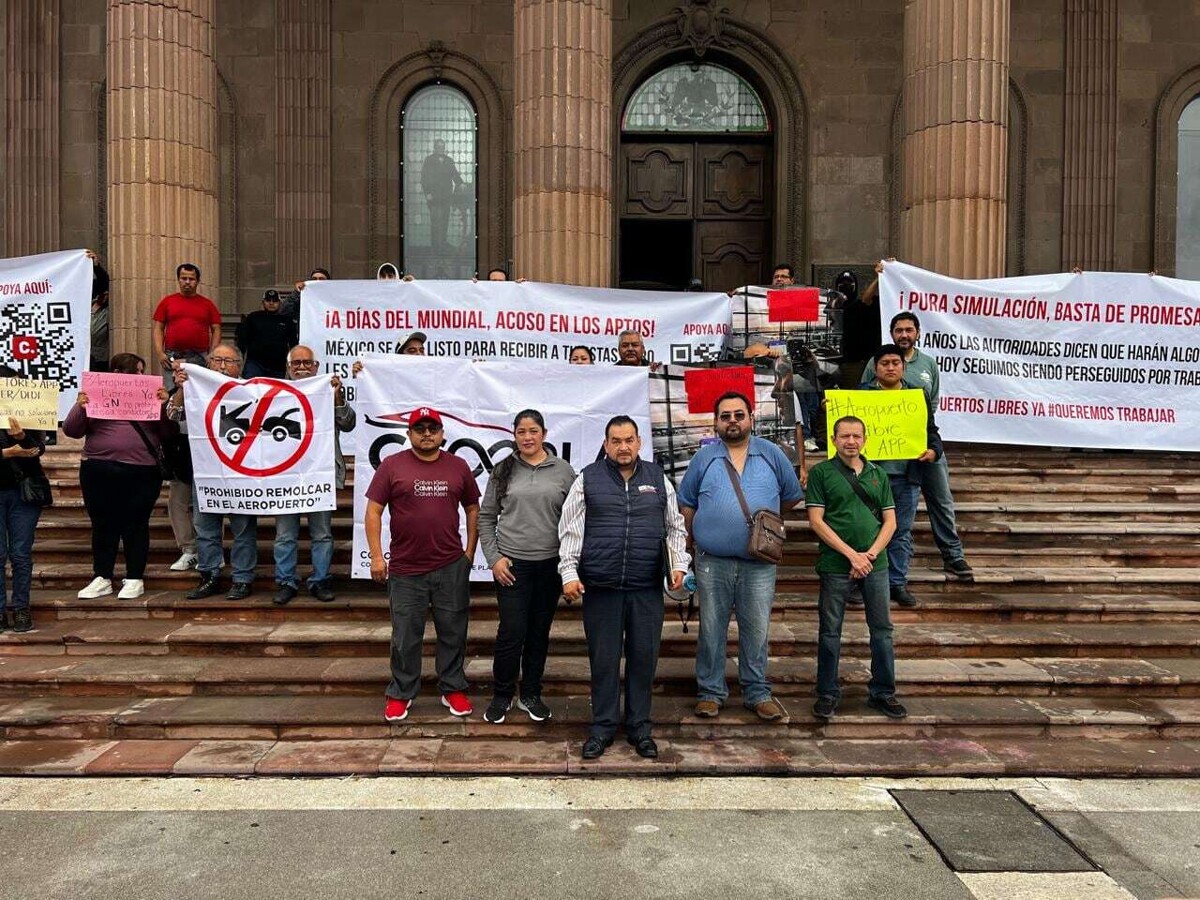
The collective of digital platform drivers in Nuevo León (Ccoopla) went to the Government Palace to formally request the support of Governor Samuel García. Some 150 drivers are seeking that the state governor intercede with the Federation to obtain a definitive permit that allows them to operate at the Monterrey International Airport without being pursued. Cristina Marmolejo, Ccoopla's representative in the state, delivered a document addressed to the state executive through the Secretary of Government, highlighting the urgency of mediation with the Ministry of Infrastructure, Communications and Transport. She noted that this movement was carried out in parallel in the other two World Cup host cities, Guadalajara and CDMX. "We come to the State Government to request the intervention of Governor Samuel García so that he gives us a voice through the Federation, helps us to be heard, and helps us get a definitive solution. The Federation is just 'kicking the can down the road'", affirmed Marmolejo. In December, Alejandro Hütt, FIFA's Host City Manager for Monterrey, told Publimetro that an alliance was made with Uber to review the state's transportation and mobility plan during the World Cup. "We have meetings with them next week (after the World Cup draw) to see all the recommendations," said Hütt. Marmolejo described it as a contradiction that while digital platforms are official sponsors of the world's most important sporting event, local drivers are prohibited from working at the airport, which tarnishes the mobility image the state seeks to project for tourists. "It's ironic that the two strongest platforms appear as FIFA World Cup sponsors and in practice we are forbidden from providing service inside the airport. That's an irony," she pointed out. The state's mobility efforts for the World Cup will not be sufficient if the 60,000 legal platform taxi operators in Nuevo León are excluded. "Undoubtedly, all the efforts that can be made in terms of mobility will not be enough if access to the airport is not resolved," she added. They denounced harassment and fines of 45,000 pesos. The collective denounced constant harassment by the National Guard, which carries out operations in federal zones, including cell phone checks and vehicle impoundment. These actions result in economic sanctions that they find suffocating for formal workers who pay taxes and social security. "It also generates very, very high fines that are over 45,000 pesos plus what the tow truck, the impound lot, and the days you are not providing the service generate," detailed Marmolejo. The collective's representative described these actions as a "persecution" of workers. Unlike Guadalajara, where spaces have been enabled next to terminals for passenger pickup, drivers in Nuevo León demand direct access to the terminals so as not to inconvenience the user. "We don't want the states, the state governments, to try to solve the problem by giving us distant places to go pick up users, we seek that if there is already infrastructure within the airports themselves... we are allowed to go pick up passengers there". The platform drivers agreed that if they do not find an echo in the State Government to open effective negotiation tables with the Federation, they will continue with mobilizations in the city. "We no longer want dialogue tables if they are not going to have a solution because they are simply sterile," expressed Marmolejo.