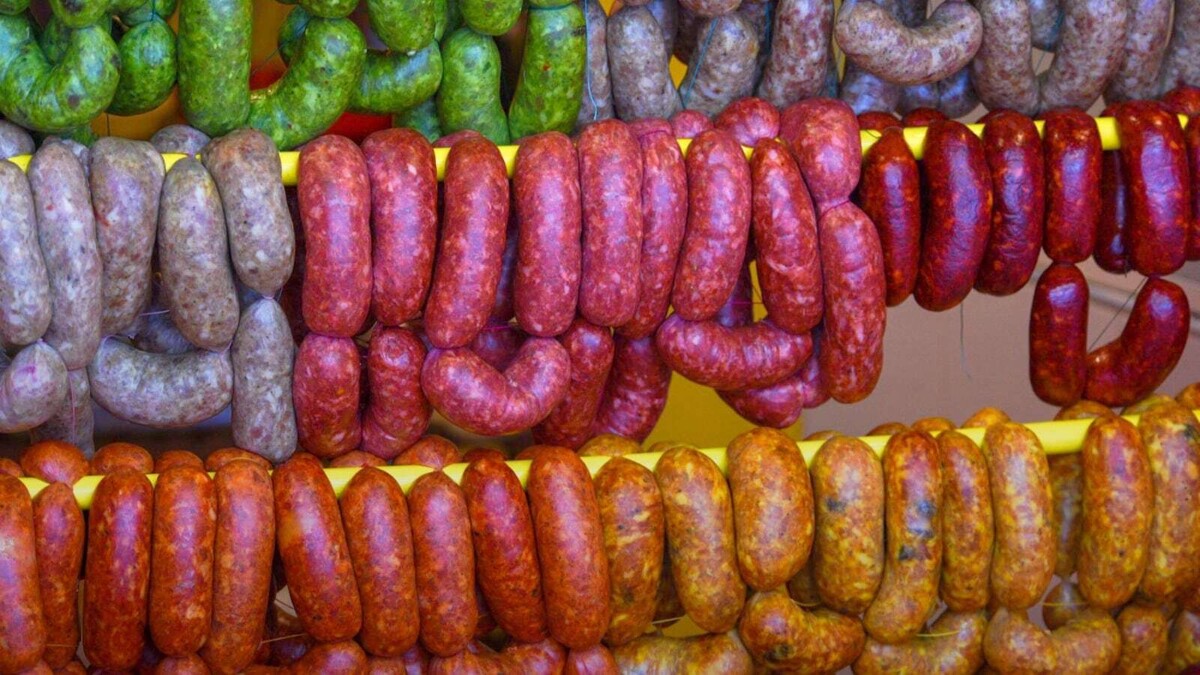
There are chorizos for the market, for the connoisseur, for the special order. He did not arrive with empty hands; on his expeditions already traveled the bacon, the salted meat, and the hams. Dozens of families continue to make chorizo, passing down recipes, defending techniques, sustaining a craft that is, at the same time, a livelihood and an inheritance. Because Toluca chorizo is not just a product. Toluca was already a chorizo city. It is proof that Mexican cuisine was not born of purity, but of mixture. A direct heir to the viceregal tradition, it finds its character in the dry chile — guajillo, ancho, puya. And with it, inevitably, came transformation; fresh meat gave way to cured meats, preservation techniques, the craft. The result is fresh, herbal, and delicious. Two colors, one same story. Today, although the meat no longer comes exclusively from the Toluca Valley, the tradition is still alive. Thus, fame was born. For centuries, Toluca supplied Mexico City and the mining regions of New Spain. The fame of Toluca chorizo began long before it existed as such, when the Valley of Matlatzinco — as it was formerly known — was chosen by Hernán Cortés not by chance, but by vision. It was the 16th century when Cortés, an experienced pig breeder since his years in Cuba, decided to establish his livestock ranches in this valley. A dialogue between two worlds. From Spain, he inherited the technique; the art of curing, the use of the gut, the spices, the preservation. From Mesoamerica, he took what would end up transforming it all: the chile, the herbs, the environment, the creativity. And so, what in Europe was a pale cured meat, here became red, fragrant, complex. The chile gave it color, it gave it identity. By the 18th century, cookbooks were documenting preparations that today seem surprisingly familiar to us: pork mixed with spices, vinegar, wine, dried fruits. Recipes where clove, cinnamon, ginger coexist… but also chile, garlic, oregano. The green chorizo. For many, the first impression is one of strangeness, a cured meat that breaks all visual logic. It had to be cooked, let us remember that the Spanish one is a cured or semi-cured meat, ours is raw. However, speaking of Toluca chorizo is, in reality, speaking in the plural. All of them, however, share the same principle: the balance between the meat, the chile, and the time. The red chorizo is, without a doubt, the oldest. Probably arisen in the 20th century, this chorizo maintains the base of the red, but changes the language: cilantro, green chile, pepita, parsley, tomato. The unexpected. The intelligence of transforming what arrives into something of its own. And perhaps that is its true strength, that in every piece of this cured meat — red or green — there is not only meat, spices, and time… there is history. A story that, like the best chorizos, is not explained: it is left to rest… and shared. The proportions change, the spices, the secrets. Of adaptation. It is a mixture. Its hams, its longanizas, its chorizos began to circulate not only as food, but as a symbol of quality. Travelers, chroniclers, and merchants all agreed on the same thing: Toluca was already a benchmark. Its products were sold in markets, transported to other regions, and eventually crossed the ocean sealed in cans and submerged in lard, traveling from Veracruz to Europe, as if inside it preserved not only the meat, but the memory of its origin. Even in the early 19th century, Alexander von Humboldt observed that in the valley “pigs had multiplied greatly” and that from there was made “a very lucrative business of hams,” confirming the importance and prestige of its products. But the chorizo — like so many things in Mexico — is not a pure invention. But it is enough to try it to understand that it is not an anomaly, but an evolution. A cuisine that does not copy, but adapts. By the 19th century, the fame was indisputable. There are stories that do not begin in the kitchen, but in the land. The disconcerting. Some incorporate almonds, pine nuts, raisins; others play with wine, vinegar, or even brandy. It is deep, spicy, slightly acidic, with that complexity that only slow fermentation gives, that invisible dialogue between the meat and the microorganisms that transform it. And then there is the other. He perhaps knew better than anyone that the pig not only feeds, but also transforms territories. At an altitude of over 2,200 meters, the Toluca Valley offered the essential: cold, corn, and time; the perfect conditions for raising pigs and transforming their meat into something durable. Soon, the raising of pigs not only prospered, but became a central economic activity. Because there is not just one. For decades — perhaps centuries — each family, each producer, has developed its own recipe.