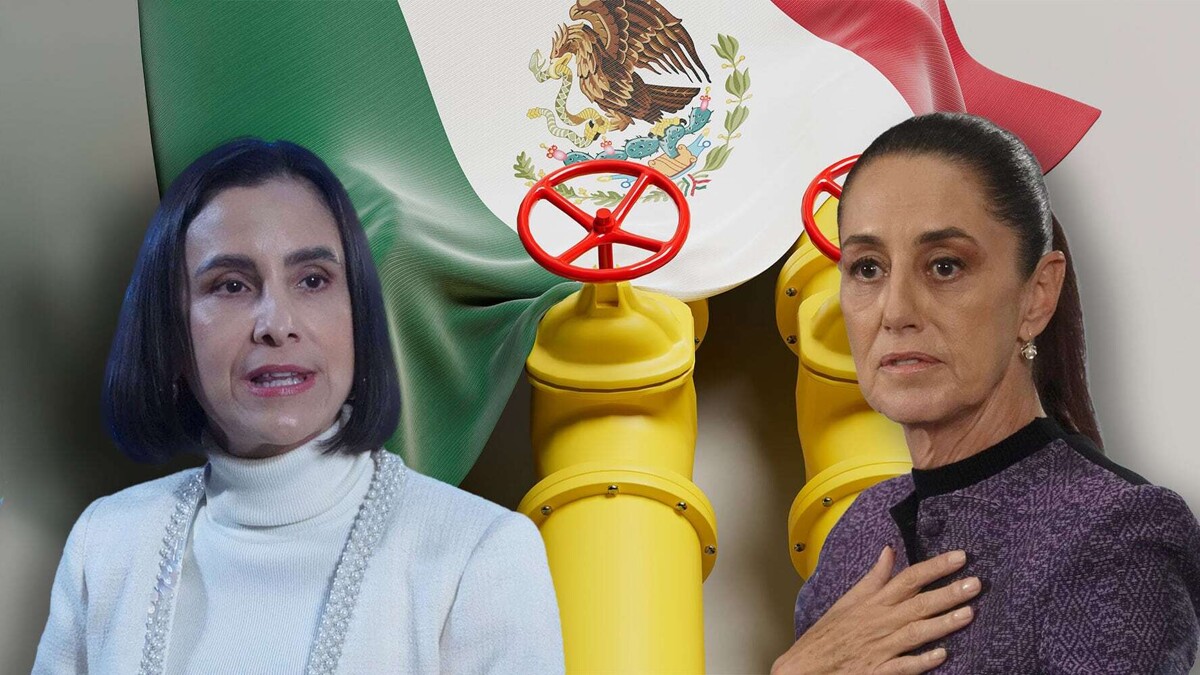
Mexico lacks strategic reserves: its storage is limited to two or three days of inventory in pipelines. The strategy presented yesterday rests on two pillars: raising renewables from 24% to 38% by 2030 and more than doubling gas production, from 2,300 to 5,871 million cubic feet per day. Even if the target is met, Mexico will continue to import considerable volumes. Total gas sovereignty is not on the horizon; what can be achieved is reducing vulnerability. However, renewables do not replace gas as a backup; they only moderate the growth of its demand. The gas pillar is where the plan becomes bold. The prospective resources—83 billion cubic feet in conventional and 141 billion in non-conventional—are geologically real, but a prospective resource is not a proven reserve or commercial production. The massive exploitation of non-conventional fields will take three to four years to yield results. Mexico has already taken some steps on this path. But doubling production in five years requires massive capital, transparency, and the humility to recognize that Pemex needs partners. Mexico has the resource at its feet. It is best not to confuse one thing with another. The renewable pillar is the most realistic. Mexico has an enviable solar resource, and the goal is achievable if regulatory bottlenecks are resolved. Yesterday's presentation by the Secretary of Energy, Luz Elena González Escobar, marks a turning point in the government's energy policy. After years of postponing the issue, the Sheinbaum administration has put the sector's most uncomfortable dependency on the table: Mexico imports 75% of the natural gas it consumes, almost all from Texas. Demand is around 9.1 billion cubic feet per day; Pemex contributes only 2.3 billion. 80% of the imported gas comes from Texas, which turns the electrical system—where over 60% of generation depends on combined-cycle gas—into a hostage to foreign decisions. Tensions between the United States and Iran showed that the fragility is not theoretical. North American Henry Hub gas hovers at $4 to $4.30 per million BTU. Producing non-conventional gas in Mexico would cost significantly more: Pemex's wells in Burgos cost between $11 and $12 million each, well above the Texan ones. In 2017, Burgos was opened to private investment, but production had already fallen by 32%. During this year's winter storm, Sistrangas (the gas transportation and storage system) was declared in critical alert, and there were blackouts. Both objectives are legitimate. The problem lies in the 'how.' And there is an aggravating factor that the presentation minimized: demand will not stay static. The government plans to add seven combined-cycle plants between 2026 and 2027, five more after that, and increase fertilizer and petrochemical production. The question is not geological, but institutional. The answer will be measured not in presentations, but in cubic feet. Pemex acknowledged that its work was equivalent to what was done in the US 20 years earlier. Demand would grow 30% by the end of the six-year term. Between 2010 and 2013, Pemex drilled at least six wells in the Mexican extension of Eagle Ford, in Coahuila: only two reached commercial production, with flows much lower than on the Texan side. And the water recycling that the government proposes as an environmental solution remains economically onerous. The farm-outs through which Pemex seeks private investment will depend on legal certainty, which is diffuse after the 2024 reform and amid the review of USMCA. The change of course is welcome. The previous six-year term froze everything. What is presented today does not start from zero, but neither from a solid base. And here the most relevant political data: although the president and other officials did not openly use the word 'fracking,' the reality is that horizontal drilling with hydraulic resources is an option. What until February was a 'topic under analysis' is now a made decision, conditional on a scientific committee—working for four months and to be presented next week—validating lower-impact technologies. The turn is notable, but the technique does not change by decree. The underlying question is whether the announced goals can withstand the contrast with technical, financial, and environmental reality. The diagnosis is impeccable, but it would have been better to have it for some years now. After a six-year term that treated fracking as a forbidden word while deepening dependence on Texan gas—produced, ironically, with the same technique—the honesty of the new diagnosis is commendable.